
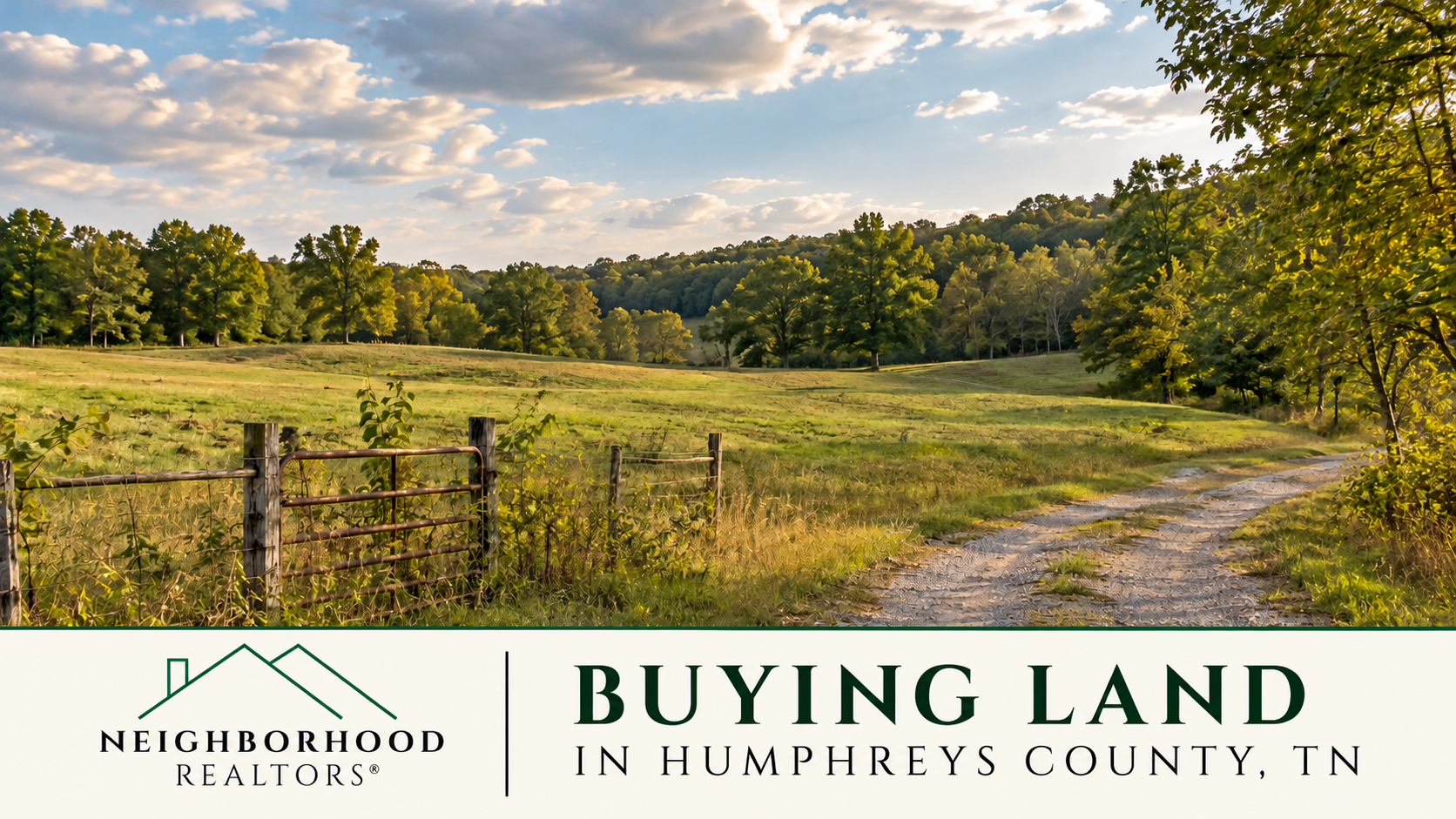
Buying land in Humphreys County, TN can open the door to building a home, starting a small farm, creating a recreational retreat or simply enjoying more space. From wooded acreage near Hurricane Mills to open land around McEwen, Waverly and New Johnsonville, the county offers a wide range of rural-property opportunities.
However, purchasing vacant land is different from buying an existing home. A beautiful tract may not automatically be suitable for the buyer’s intended plans. Access, utilities, soil conditions, restrictions and development costs should all be evaluated before the purchase becomes final.
Here are ten important things to consider before buying land in Humphreys County.
1. Decide How You Intend to Use the Property
Begin by identifying what you want the land to provide. Are you looking for:
- A homesite;
- A farm or homestead;
- Hunting or recreational property;
- Pasture for livestock;
- Timberland;
- An investment;
- Commercial property; or
- Acreage to divide among family members?
A tract that works well for recreation may not be suitable for residential construction. Likewise, property that appears large enough to divide may be affected by road frontage, soil conditions, utility availability or subdivision requirements.
Establishing your intended use early helps your REALTOR® identify the right questions and avoid properties that are unlikely to meet your goals.
2. Confirm Legal and Practical Access
A property should have more than a path that appears to connect it to a road. Buyers should determine whether the tract has direct public-road frontage or relies on an easement across neighboring property.
When access is provided by an easement, important questions include:
- Is the easement written and recorded?
- Where is it located?
- How wide is it?
- Who is responsible for maintenance?
- Does it allow utility installation?
- Is the existing road actually located within the easement?
Access that works for a pickup truck may not be sufficient for construction equipment, emergency vehicles or utility installation. It is important to evaluate both the legal right of access and the physical condition of the route.
3. Do Not Rely Solely on Online Boundary Maps
Tax maps, listing maps and aerial images are useful starting points, but they are not substitutes for a boundary survey.
A survey can help identify:
- Property lines;
- Acreage;
- Road frontage;
- Encroachments;
- Easements;
- Rights-of-way;
- Existing improvements; and
- Potential boundary discrepancies.
Old fences, trails and tree lines do not necessarily follow the legal boundary. If the precise location or acreage is important to your plans, consider obtaining a current survey during the due-diligence period.
4. Investigate Soil and Septic Suitability
Many rural properties in Humphreys County are not connected to a public sewer system. Before purchasing land for a home, buyers should investigate whether the property can support an approved septic system.
Although people commonly refer to this as a “perc test,” Tennessee’s process may involve a site evaluation, soil mapping and approval from the Tennessee Department of Environment and Conservation. The proposed homesite, number of bedrooms, driveway, utilities, wells and other site features may affect the septic-system design.
A property may require:
- A conventional septic system;
- Additional soil evaluation;
- A larger disposal area;
- A designated duplicate or reserve area; or
- A more expensive alternative system.
Buyers should avoid assuming that acreage alone guarantees septic approval. The location and characteristics of the usable soil are often more important than the property’s total size.
5. Verify Utilities Before Making Plans
Utility availability can vary considerably between properties, even when they are located near one another.
Before purchasing, determine the availability and potential cost of:
- Electricity;
- Public water;
- Natural gas or propane;
- Internet service;
- Cellular coverage; and
- Private well installation, if needed.
A utility line visible near the property does not necessarily mean service is available at the desired building site. Long driveways or remote homesites can significantly increase the cost of extending electricity, water and communications infrastructure.
Contact the applicable utility providers directly and ask whether service is available, where the nearest connection is located and whether extension charges may apply.
6. Review Flood Risk and Drainage
Humphreys County includes properties near the Tennessee, Duck and Buffalo Rivers, along with numerous creeks, branches and low-lying areas. Buyers should examine flood information even when a tract is not located directly beside a major body of water.
The FEMA Flood Map Service Center can help identify mapped flood zones, but a map review should be only one part of the investigation. Buyers should also examine:
- Drainage patterns;
- Creek and stream crossings;
- Low areas;
- Culverts;
- Evidence of erosion;
- The elevation of a potential homesite; and
- Whether access could be affected during periods of high water.
Flood-zone status can affect construction requirements, insurance availability, financing and the portion of the property that can reasonably be developed.
7. Walk the Property and Study the Terrain
Acreage can look very different on the ground than it does in photographs. Whenever possible, walk the property with appropriate permission and evaluate its physical characteristics.
Consider:
- Steep slopes;
- Rock outcroppings;
- Wet areas;
- Existing trails and roads;
- Timber condition;
- Pasture quality;
- Fencing;
- Creek crossings;
- Dump sites or debris; and
- The amount of truly usable acreage.
A lower-priced tract may require extensive grading, driveway construction, drainage work or clearing. Those costs should be considered alongside the purchase price.
8. Check Restrictions and Land-Use Requirements
Do not assume that rural land is unrestricted. Property may be affected by:
- Recorded restrictive covenants;
- Conservation easements;
- Utility easements;
- Rights-of-way;
- Subdivision restrictions;
- Municipal requirements;
- Floodplain regulations; or
- Conditions shown on a recorded plat.
Requirements may also differ depending on whether the property lies inside Waverly, McEwen or New Johnsonville or in an unincorporated portion of Humphreys County.
If you intend to divide the property, build multiple residences, place manufactured housing, operate a business or use the land for another specific purpose, investigate the applicable requirements before closing. The Humphreys County Planning Commission reviews subdivision plats, and additional approvals may apply depending on the property’s location and proposed use.
9. Understand Land Financing
Financing vacant land is often different from financing an existing residence. Some land loans require a larger down payment, shorter repayment term or different appraisal process.
Before beginning a serious search, speak with a lender familiar with rural-property transactions and discuss:
- Your intended use;
- The type and size of the tract;
- Whether construction is planned;
- Down-payment requirements;
- Loan terms;
- Appraisal requirements; and
- Whether utilities or improvements are required.
Buyers should also budget for expenses beyond the purchase price, including surveys, soil evaluations, title work, driveway construction, clearing, utility extensions and septic installation.
10. Review the Title, Easements and Recorded Documents
A title examination can identify matters that may not be visible during a property visit.
These may include:
- Mortgages and liens;
- Access easements;
- Utility easements;
- Restrictions;
- Rights-of-way;
- Prior conveyances;
- Mineral or timber interests;
- Boundary descriptions; and
- Other recorded interests affecting the property.
Land transactions frequently involve older legal descriptions and multiple prior conveyances. Buyers should use appropriate title, legal, surveying and other professionals to evaluate issues affecting a particular property.
Local Knowledge Matters When Buying Rural Property
Humphreys County offers everything from smaller residential lots to farms, wooded tracts, hunting property and large rural acreage. Each property presents its own combination of access, terrain, utilities, soils and recorded rights.
Working with a local real estate professional can help you:
- Identify properties that align with your intended use;
- Ask the right questions early;
- Coordinate inspections and due diligence;
- Understand local property characteristics; and
- Navigate the transaction from the initial search through closing.
Neighborhood Realtors has served Humphreys County and the surrounding Middle Tennessee area since 2011. Our team works with buyers and sellers throughout Waverly, McEwen, New Johnsonville, Hurricane Mills and neighboring communities.
Ready to begin your land search?
Browse current Middle Tennessee listings or contact Neighborhood Realtors at 931-296-3131. You can also learn more about farms and rural property in Middle Tennessee and explore our Humphreys County real estate guide.
This article provides general real estate information. Property conditions, governmental requirements and transaction considerations vary. Buyers should consult the appropriate governmental agencies and qualified legal, surveying, engineering, environmental, lending and other professionals regarding a specific property.