
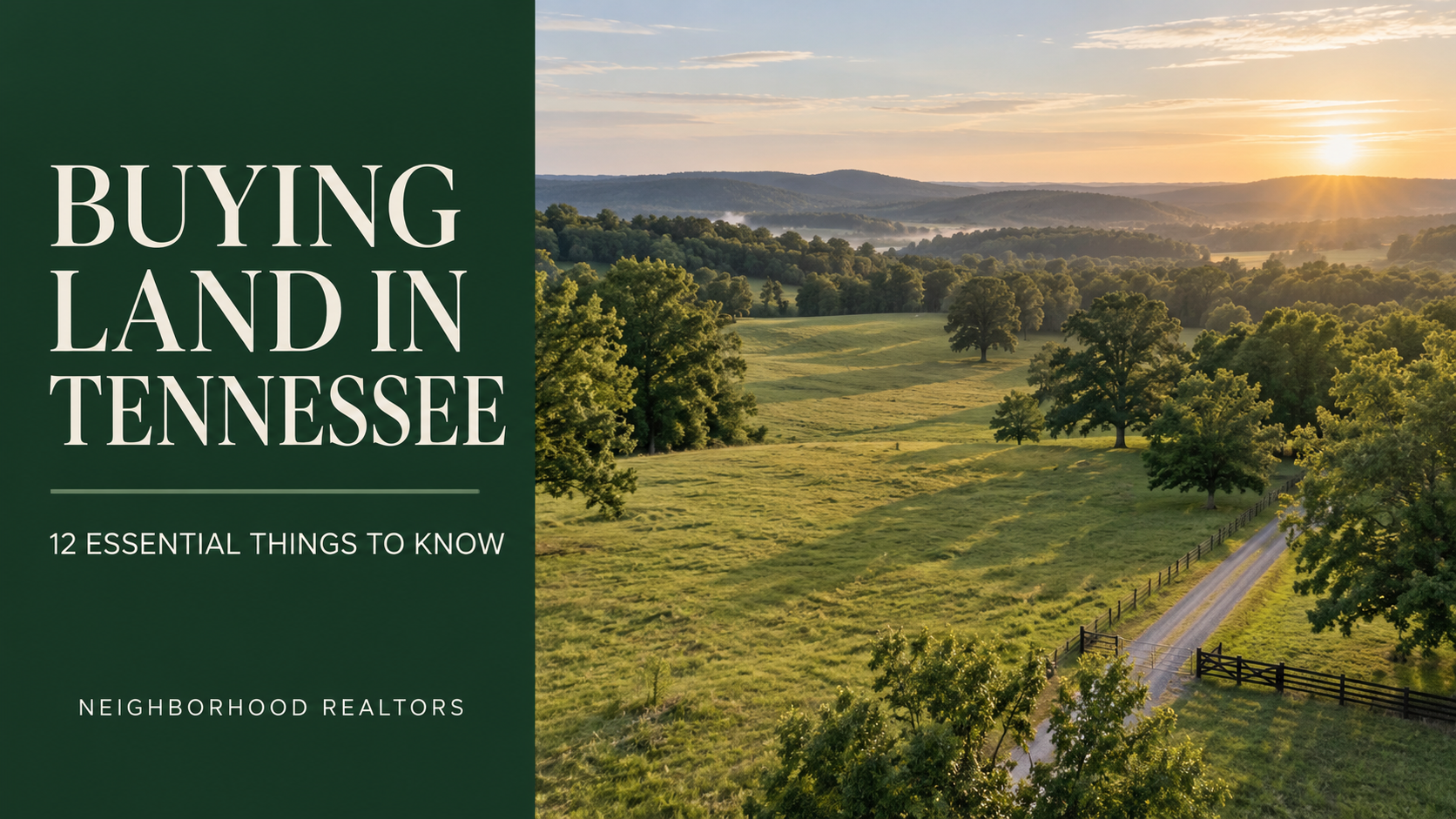
Buying land in Tennessee can look deceptively simple.
You find a tract you like, determine whether the price fits your budget and make an offer. But purchasing vacant or rural land often requires a different level of due diligence than purchasing an existing home.
Two properties that appear nearly identical on a listing can have very different practical uses. Access, topography, utilities, soil conditions, restrictions, flood considerations and financing can all affect whether a particular tract is suitable for what you intend to do with it.
For anyone buying land in Tennessee, including Waverly, Humphreys County and surrounding Middle Tennessee communities, here are some of the issues worth investigating before committing to a purchase.
1. Buying Land in Tennessee Starts With Your Intended Use
Before evaluating a tract of land, define your intended use.
Are you looking for a homesite? Recreational property? Hunting land? A small farm? Additional acreage adjoining property you already own? A long-term investment? Commercial development?
The answer matters because a tract that works well for one purpose may be poorly suited for another.
For example, heavily wooded acreage with significant elevation changes may be attractive recreational property but could create additional costs if your goal is to construct a home, driveway and other improvements.
Likewise, a beautiful open tract may not automatically be suitable for the type of development a buyer has in mind.
Your intended use should drive the questions you ask during the purchase process.
2. Confirm Legal and Practical Access
Access is one of the first issues a land buyer should investigate.
A property appearing to touch a roadway on a map does not necessarily answer every question about access. Likewise, a driveway or trail that has historically been used to reach a property does not necessarily establish the nature or extent of the legal right to use it.
Depending upon the property, buyers may need to investigate matters such as:
- Public road frontage;
- Recorded easements;
- Shared driveways or private roads;
- Maintenance obligations;
- The location and width of access easements; and
- Whether existing access is adequate for the buyer’s intended use.
Access can also affect financing, construction and future marketability.
When access depends upon an easement or private road, the underlying documents should be reviewed carefully rather than relying solely upon the property’s current physical appearance.
3. Understand the Property’s Boundaries
Fences, tree lines, roads and fields do not necessarily correspond with legal property boundaries.
That becomes particularly important with rural acreage.
A current survey can help identify the property’s boundary lines and may disclose matters such as easements, encroachments, acreage discrepancies or other physical conditions affecting the tract.
Whether a new survey is appropriate depends upon the particular transaction, the existing property records and the buyer’s intended use.
For someone planning a home, fence, driveway or other substantial improvement near a property line, knowing where the boundaries actually lie can be especially important.
4. Investigate Utilities Before Assuming They Are Available
A listing stating that utilities are “available” deserves additional investigation.
For land buyers, the more useful questions are often:
Which utilities are available, where are they located, and what will it cost to extend service to the proposed building site?
Depending upon the location, buyers may need to investigate:
- Electric service;
- Public water;
- Natural gas;
- Internet or broadband;
- Well requirements; and
- The distance from existing utility infrastructure to the intended improvement site.
A utility located along the roadway may still be hundreds or thousands of feet from where a buyer wants to construct a home.
Those distances can materially affect development costs.
Buyers should verify utility availability directly with the appropriate utility providers rather than assuming that nearby service guarantees economical connection to the property.
5. Septic and Soil Conditions Can Be Critical
Many rural Tennessee properties are not served by public sewer systems.
If you intend to build a residence or another structure requiring wastewater disposal, the property’s suitability for a septic system can therefore become a major part of the purchase decision.
A large tract of land does not automatically mean that every portion—or any particular portion—is suitable for the septic system required for the buyer’s plans.
Soil characteristics, topography, proposed bedroom count, system design and applicable governmental requirements can all matter.
Buyers planning to build should determine what testing or governmental approvals are appropriate for the property and consider making satisfactory results part of their due diligence before becoming fully committed to the purchase.
6. Look Beyond the Total Acreage
When evaluating land, the number of acres is only part of the story.
Twenty acres of relatively level, accessible ground can provide very different possibilities from twenty acres consisting primarily of steep terrain.
Consider the property’s:
- Elevation changes;
- Drainage;
- Creeks and waterways;
- Timber;
- Open versus wooded acreage;
- Road frontage;
- Existing trails or roads;
- Usable building areas; and
- Accessibility throughout the tract.
The right combination depends upon your intended use.
A recreational buyer may value timber, water and varied terrain. Someone purchasing a homesite may place considerably more emphasis on accessibility, utilities and buildable ground.
7. Check Flood Information and Drainage Conditions
Water can substantially affect both the use and value of land.
Buyers should investigate whether any portion of the property lies within a mapped flood hazard area and consider how water actually moves across the property.
FEMA flood maps are a useful starting point, but they should not necessarily be the end of the investigation.
Creeks, low areas, drainage patterns, culverts and neighboring terrain can all influence how a property behaves during significant rainfall.
This is especially important when selecting a future building site or considering improvements such as roads, driveways, barns or other structures.
8. Review Restrictions, Easements and Other Title Matters
Owning land does not necessarily mean the property can be used in any manner the owner chooses.
Recorded instruments affecting the property may contain restrictions or easements that influence its use.
Depending upon the property, title work may reveal matters involving:
- Utility easements;
- Access easements;
- Restrictions or covenants;
- Rights-of-way;
- Mineral or other reserved interests; or
- Other recorded matters affecting title.
A buyer should understand these matters before closing, particularly when the purchase is being made for a specific planned use.
A title company or attorney can address the legal effect of title documents; the real estate agent’s role is to help keep those issues identified and moving through the transaction.
9. Don’t Assume Zoning or Land-Use Rules
Land-use regulation varies considerably by location.
Property inside a municipality may be subject to different requirements than property in an unincorporated portion of a county. The applicable rules can also depend upon the proposed use.
If your purchase depends upon a particular use—such as constructing multiple residences, operating a business, subdividing the tract or developing commercial property—you should confirm the applicable requirements with the appropriate governmental authority.
A property’s current use or a neighboring property’s use does not necessarily establish what will be permitted on the property you’re considering.
10. Land Financing Can Be Different From Home Financing
Financing when buying land in Tennessee can be different from financing an existing residence.
Loan products, down-payment requirements, interest rates, appraisal considerations and repayment terms may vary depending upon the lender and type of property.
Some lenders specialize in rural or agricultural property, while others may have limited appetite for vacant acreage.
If financing will be required, speaking with lenders early in the search process can help establish realistic parameters before you make an offer.
The same applies if you intend to purchase land now and obtain construction financing later. Understanding both stages of financing before the land purchase can help avoid surprises.
11. Consider the Cost of Making the Property Usable
The purchase price is not necessarily the total cost of acquiring usable land.
Depending upon the property and your plans, additional expenses might include:
- Surveying;
- Clearing;
- Driveway construction;
- Culverts;
- Utility extensions;
- Well installation;
- Septic installation;
- Excavation and grading;
- Fencing; or
- Site preparation.
A lower-priced tract requiring substantial infrastructure may ultimately cost more than another property with a higher purchase price but better existing access and utility availability.
Looking at the entire project rather than only the asking price can produce a much better comparison between properties.
12. Build Appropriate Due Diligence Into the Offer
One of the most important parts of purchasing land occurs before the contract is signed.
When a buyer has specific concerns about a property, the purchase agreement should appropriately address the investigation that needs to occur.
Depending upon the transaction, that could involve time to investigate matters such as financing, surveys, title, access, utilities, soil suitability, governmental requirements or other property-specific conditions.
The appropriate terms depend upon the particular transaction.
The important point is simple: identify your critical questions before making the offer rather than after your contractual deadlines have begun to expire.
There Is No Substitute for Property-Specific Investigation
There is no universal checklist that can determine whether every tract of Tennessee land is a good purchase.
A five-acre building site outside Waverly presents different considerations from a 100-acre recreational tract, an operating farm or commercial acreage along a major highway.
That is why land transactions benefit from a property-specific approach.
A knowledgeable real estate professional can help identify the questions that should be asked, coordinate the transaction and connect buyers with surveyors, lenders, inspectors, governmental agencies, title professionals and other specialists when their expertise is needed.
The ultimate goal isn’t simply to buy acreage.
It’s to purchase property that actually works for what you intend to do with it.
Looking for Land in Middle Tennessee?
Neighborhood Realtors is a locally owned real estate brokerage based in Waverly, Tennessee. Our team works with buyers and sellers of land, acreage, homes, farms and rural property throughout the Middle Tennessee communities we serve.
Whether you’re searching for a building site, recreational acreage or a larger tract of land, we can help you evaluate available properties and navigate the real estate transaction.